
Global student-led initiative invites young people to develop innovative, evidence-based solutions to urban climate challenges, with registration open until 20 November 2026.
8 November 2026 | GLOBAL — As cities around the world confront increasingly complex environmental challenges, from rising temperatures and extreme rainfall to pollution, resource depletion, and unsustainable urban development, a new generation of young innovators is being called upon to imagine and design a more sustainable future.
The Global Student Climate Research and Action Network (GSCRAN) has announced the launch of the Climate SMART Solutions Pitch Challenge 2026, an international student innovation initiative that invites young people to develop practical, creative, and evidence-informed approaches to building climate-resilient cities.
Anchored in the vision of “Reinventing Cities for a Climate-Resilient Future,” the challenge encourages students to move beyond simply recognizing environmental problems and begin designing solutions that could transform the communities in which they live.
The initiative aligns with the United Nations Sustainable Development Goals, particularly SDG 12: Responsible Consumption and Production and SDG 13: Climate Action, by encouraging students to examine how their communities consume resources, manage waste, respond to environmental risks, and prepare for a changing climate.
Moving Beyond Climate Awareness Toward Climate Action
Climate change education has increasingly emphasized the importance of equipping young people not only with scientific knowledge but also with the capacity to apply that knowledge to real-world challenges.
However, understanding climate change and responding effectively to its consequences are two different undertakings.
The Climate SMART Solutions Pitch Challenge seeks to bring these dimensions together by providing students with an opportunity to investigate environmental problems, formulate solutions, and communicate their proposals to a wider audience.
Participants will be encouraged to examine the communities and cities in which they live, identify pressing sustainability challenges, and propose two bold yet workable ideas that could contribute to creating cleaner, greener, and more climate-resilient urban environments.
The competition welcomes individual participants and student teams, recognizing that meaningful innovation can emerge through independent inquiry as well as interdisciplinary collaboration.
Rather than limiting students to a single environmental issue, the challenge allows participants to investigate a wide range of concerns, including solid waste management, green transportation, water conservation, renewable energy, and sustainable urban planning.
Students are also encouraged to explore how emerging technologies, scientific research, and community-based approaches could support their proposed solutions.
Students as Researchers, Designers, and Changemakers
At the heart of the initiative is the belief that young people have the capacity to contribute meaningfully to sustainability discussions when they are provided with opportunities to investigate problems and develop their own ideas.
The competition therefore encourages participants to approach environmental challenges through research, creativity, and critical thinking.
For example, students investigating urban flooding might examine how permeable surfaces, green infrastructure, or improved drainage could reduce local climate risks. Others may explore community-based waste segregation, energy-efficient public facilities, or low-cost technologies for conserving water.
The challenge is not simply to propose an appealing concept but to explain how that concept could work in practice.
Participants are encouraged to consider the communities that would benefit from their proposals, the resources required for implementation, and the potential limitations of their solutions.
Through this process, students can develop a deeper understanding of sustainability as a complex issue involving environmental, technological, social, and economic considerations.
An International Platform for Student Innovation
The Climate SMART Solutions Pitch Challenge also aims to create opportunities for students to engage with an international community of learners, educators, researchers, and sustainability advocates.
Participants will have opportunities to learn from international experts, receive feedback on their ideas, and develop their capacity to communicate environmental solutions to different audiences.
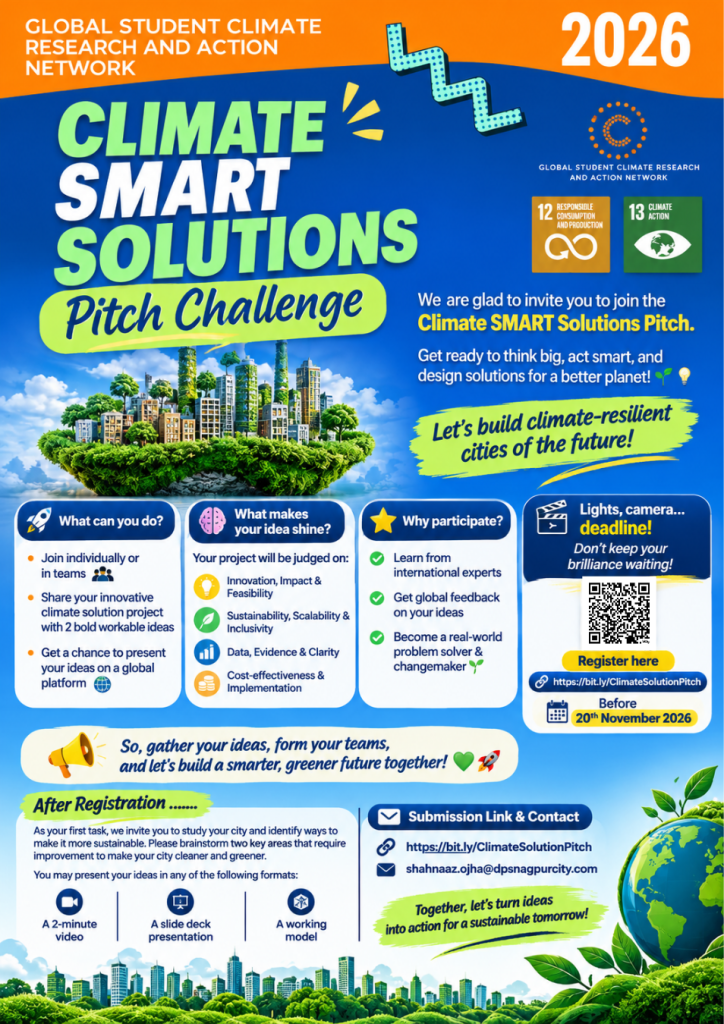
Projects will be evaluated using four principal areas:
- Innovation, Impact, and Feasibility: The originality of the solution, its potential benefits, and its practicality.
- Sustainability, Scalability, and Inclusivity: The project’s long-term environmental relevance, potential for wider application, and accessibility to different communities.
- Data, Evidence, and Clarity: The quality of supporting research, scientific evidence, and communication.
- Cost-effectiveness and Implementation: The consideration of available resources, financial feasibility, and practical steps needed to implement the proposed solution.
These criteria reflect the initiative’s emphasis on balancing creativity with scientific reasoning and practical action.
Following the initial evaluation, selected entries will advance to the final round. The top three winners will receive an opportunity to showcase their work during the award ceremony.
How Students Can Participate
Interested students may register individually or as teams through the competition’s official link.
Following registration, participants are invited to study their cities or local communities and identify two key areas where improvements could enhance environmental sustainability and climate resilience.
Students may present their proposals through a two-minute project video, a slide deck presentation, or a working model.
Submissions should demonstrate the environmental issue being addressed, the proposed solution, and how the idea could contribute to a more sustainable city.
Participants submitting project files should clearly identify their name, school, and country.
Important dates:
- Registration deadline: 20 November 2026
- Project submission deadline: 30 November 2026
Participants may access the competition through the official link:

Additional information about GSCRAN and its international student initiatives is available at https://gscran.org/.
For inquiries, participants and interested schools may contact shahnaaz.ojha@dpsnagpurcity.com.
Reimagining the Future Through Young People’s Ideas
The challenge represents a broader call to rethink the role of young people in responding to global environmental problems.
Cities are not simply collections of buildings, roads, and infrastructure. They are interconnected systems shaped by human decisions, ecological processes, technological developments, and social relationships.
Consequently, building climate-resilient cities requires more than isolated environmental interventions. It demands innovative thinking, interdisciplinary collaboration, and the willingness to examine how different systems interact.
Through the Climate SMART Solutions Pitch Challenge 2026, GSCRAN hopes to encourage students to recognize their potential as contributors to these discussions.
The initiative also emphasizes that meaningful climate action need not begin with large-scale investments or highly advanced technologies. It may begin with a student observing a recurring problem in their neighborhood, asking why it occurs, and investigating how that problem might be addressed.
By connecting scientific inquiry with creativity and practical problem-solving, the challenge seeks to transform environmental concern into ideas that could inspire future action.
The future of climate-resilient cities should not only be imagined for young people; it should also be imagined and shaped by them.
As GSCRAN opens the Climate SMART Solutions Pitch Challenge 2026 to young innovators, the invitation is clear: examine your city, question what could be improved, and develop the solutions that tomorrow’s communities may need.
Think big. Act SMART. Reinvent cities for a climate-resilient future.


Leave a Reply