
Education Summit 2026: Deadline 2030 Concludes with Regional Call to Accelerate SDG 4 for ASEAN Education Transformation
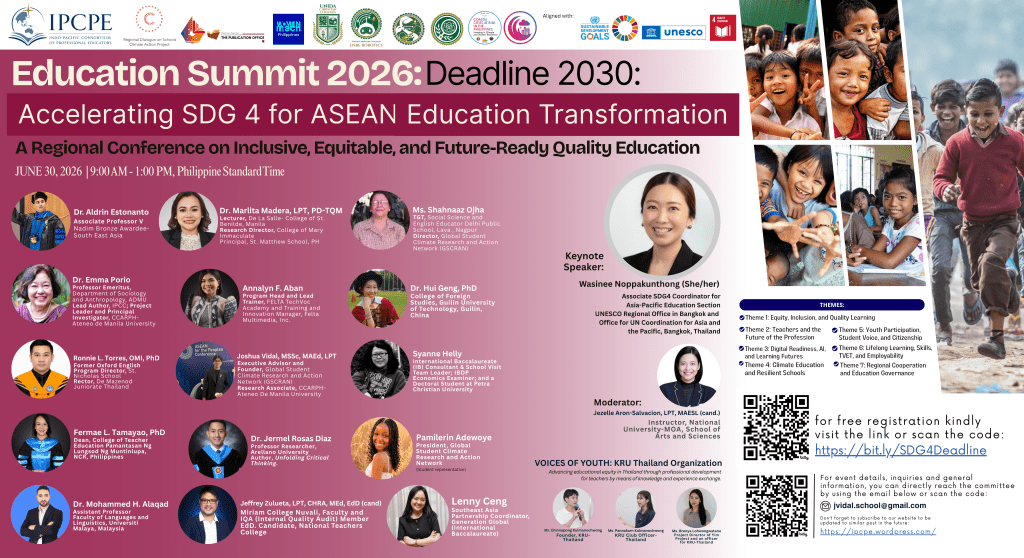
The Education Summit 2026: Deadline 2030 — Accelerating SDG 4 for ASEAN Education Transformation has successfully concluded, bringing together educators, researchers, youth leaders, and education advocates in a regional dialogue on the urgent need to advance inclusive, equitable, and future-ready quality education. The summit was held in response to the approaching 2030 deadline for Sustainable Development Goal 4, emphasizing that education systems across ASEAN must move faster, collaborate deeper, and respond more meaningfully to the changing needs of learners and communities.
The summit featured Wasinee Noppakunthong (She/her) as the Keynote Speaker, serving as Associate SDG 4 Coordinator for the Asia-Pacific Education Section, UNESCO Regional Office in Bangkok and Office for UN Coordination for Asia and the Pacific, Bangkok, Thailand. Her keynote contribution highlighted the importance of accelerating SDG 4 through regional cooperation, inclusive education policies, and stronger commitments to quality learning for all.
The discussions were anchored on seven major themes: Equity, Inclusion, and Quality Learning; Teachers and the Future of the Profession; Digital Readiness, AI, and Learning Futures; Climate Education and Resilient Schools; Youth Participation, Student Voice, and Citizenship; Lifelong Learning, Skills, TVET, and Employability; and Regional Cooperation and Education Governance. These themes guided the summit’s conversations on how education can respond to today’s challenges, including inequality, climate change, digital transformation, and the need for stronger youth participation.
The summit also highlighted the participation of Ms. Shahnaaz Ojha, TGT, Social Science and English Educator at Delhi Public School, Lava, Nagpur, and Director of the Global Student Climate Research and Action Network (GSCRAN). Her participation reflected the essential role of teachers and school leaders in advancing both quality education and climate-conscious learning.
Also highlighted was Joshua Vidal, MSSc, MAEd, LPT, Executive Advisor and Founder of the Global Student Climate Research and Action Network (GSCRAN) and Research Associate of CCARPH–Ateneo de Manila University. As one of the key conveners and education advocates behind the summit, Vidal emphasized the need to connect research, education leadership, climate resilience, and regional cooperation in advancing the SDG 4 agenda.
Representing the youth sector, Pamilirin Adewoye, President of the Global Student Climate Research and Action Network (GSCRAN) and student representative, brought attention to the importance of youth voice in education transformation. Her participation underscored that young people must not only be recipients of educational reform but also active contributors in shaping more inclusive, responsive, and sustainable learning systems.
The summit concluded with a renewed commitment to continue building partnerships across schools, universities, youth networks, and education organizations. As the 2030 deadline approaches, the summit reaffirmed that achieving SDG 4 requires collective action, stronger regional solidarity, and the meaningful participation of educators and young people.


Leave a comment